Silesian identity shows up fast on foot. This Katowice Old Town Walking Tour strings together Market Square, major churches, and big-city landmarks, then lands at Spodek, the symbol of the city. I also like that the stops are listed with admission ticket free, so your money mostly buys time, context, and a good guide.
You’ll walk about 6.5 km over roughly 3 hours, so come ready for steady pavement and some time outside. One reviewer specifically praised the guide Malwina for answering questions and making the details click, especially around how Silesia shifted between Slavic and German hands.
In This Review
- Key highlights you’ll feel right away
- Where the tour starts: Silesian Theatre and an easy route rhythm
- Market Square and the communist-era shopping dream (plus the oldest buildings)
- Kościół Mariacki: a breath-taking church exterior and top Polish art inside
- The Academy of Music and Silesian Parliament: culture and autonomy on display
- A local theater stop and the Cathedral of Christ the King’s mixed spiritual story
- Stawowa and Miarka Square: 19th-century tenements and the oldest high school
- The 1939 scouts monument and the Silesian Insurgents’ Monument
- Spodek: Katowice’s city symbol in real space
- Price and value: what you’re really paying for
- What to bring and how to plan your walk
- Who this Katowice Old Town tour suits best
- Should you book this tour?
- FAQ
- How long is the Katowice Old Town Walking Tour?
- Where does the tour start?
- How far do you walk?
- Is the tour offered in English?
- Is admission included for the stops?
- Is this tour private?
- When will I receive confirmation after booking?
- What if the weather is bad?
Key highlights you’ll feel right away
- A focused 3-hour loop that connects the city’s old core to its modern icon at Spodek
- Free-entry stops across architecture, institutions, and monuments (your budget stays cleaner)
- Silesia explained through buildings, from Kościół Mariacki to the Silesian Parliament
- Monuments that anchor tough history, including Silesian uprisings and scouts opposing Nazis in 1939
- Stawowa’s street texture, with 19th-century tenements and Katowice’s oldest high school
- A practical, English-led format that’s built for understanding, not just sightseeing
Where the tour starts: Silesian Theatre and an easy route rhythm
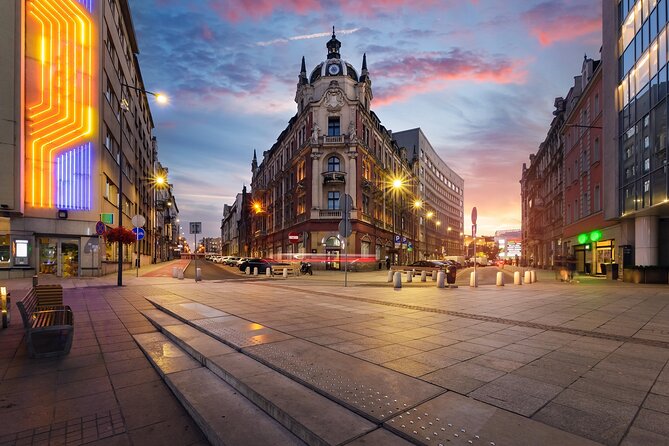
The whole experience is built around a simple idea: get your bearings, then connect the dots. You begin at Silesian Theatre at Rynek 10 in Katowice, and the tour loops back to the same meeting point at the end.
That matters because the route is compact. You’re not planning separate legs, rerouting buses, or hunting landmarks. It’s also a good setup for solo travelers: the format is a private tour/activity, so it’s just your group, not a giant crowd.
The pace is “walk and look,” not “run from photo spot to photo spot.” Still, with 6.5 km on the schedule, it’s smart to wear comfortable shoes and plan on a couple of stretches where you’ll stand and listen.
You can also read our reviews of more walking tours in Krakow



Market Square and the communist-era shopping dream (plus the oldest buildings)
Your first major stop centers on Market Square, which is where Katowice’s story becomes visible in layers. Around the square you’ll see references to older parts of the city, including the oldest buildings in Katowice, set alongside later styles and uses.
From there, you also connect to the Silesian Theatre area and two well-known shopping spots: Skarbek and Zenit. The tour frames them as the shopping dream place of communistic Poland, which is more than trivia. It’s a reminder that daily life under the communist era had its own design language—bright, structured, and built for crowds and consumption.
A practical note: Market Square is also where you’ll feel the city’s living rhythm. The tour points you toward this as a natural place for eating and drinking out, which is useful after the walk if you want to keep going on your own.
If you like city centers that mix old masonry with later planning, you’ll likely enjoy this opening. If you only want museum-level interiors, this part may feel more about architecture and vibe than deep artifacts.
Kościół Mariacki: a breath-taking church exterior and top Polish art inside
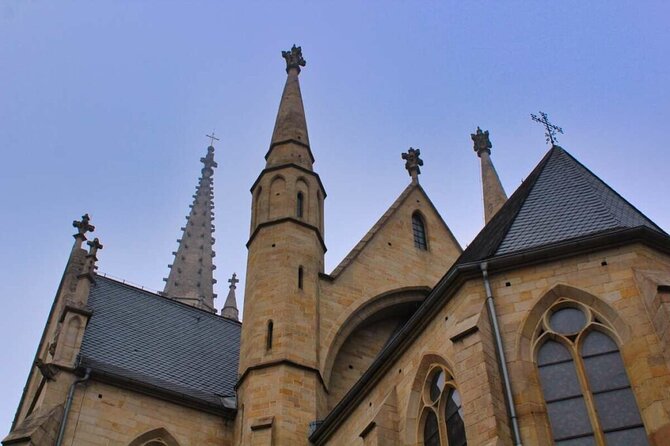
Next up is Immaculate Conception Catholic Church, known as Kościół Mariacki. The emphasis here starts outside: the tour highlights the breath-taking architecture from the exterior, which gives you an immediate sense of importance before you even step in.
Inside is the real payoff. The tour notes artworks of top Polish artists in the church, so you’re not just looking at religious space—you’re also seeing a curated national art statement housed in a historic setting.
A good way to get the most from this stop is to slow down and let your eyes move in sections: first the overall layout, then the main artworks. Churches like this often reward quiet attention more than quick snapshots.
Time is limited at this stop (about 10 minutes), so if you’re the kind of person who could spend an hour in one chapel, you might want to pair this tour with a separate self-guided revisit later.
The Academy of Music and Silesian Parliament: culture and autonomy on display
You then pass by the Academy of Music in Katowice, described as the most prestigious music academy in Poland. Even without going deep into classrooms, the building presence matters. It signals that this city isn’t only about industry and monuments. It’s also about training artists and shaping sound—serious, formal, and national-level.
Right after that, the route goes to the Silesian Parliament, marked as the former seat of parliament of the Autonomous Silesia Region. This is where the tour’s bigger theme becomes clear: Silesia’s identity was never one simple thing. It was contested, negotiated, and governed in shifting ways.
What I like about placing this stop here is sequencing. You’ve just seen a cultural institution (music), then you step into a political one (parliament). That contrast helps you understand the region as both creative and power-driven—two sides that often show up in the same streets.
This segment also works well for anyone who wants more than names on signs. If you enjoy short explanations that make the city’s institutions feel personal, this part is a strong match.
A local theater stop and the Cathedral of Christ the King’s mixed spiritual story
The walking route includes a local’s favourite theater with an informal vibe. You get a sense of where people probably go for everyday cultural life, not just official events. For many visitors, that’s exactly the kind of stop that keeps a tour from becoming a checklist.
Then you arrive at the Cathedral of Christ the King. The tour frames it as Catholic-like from the outside but Protestant-like inside, reflecting the mixed origins of the Silesia region and its spirituality. That detail is more than a neat contrast. It’s a visual reminder that Silesia’s religious culture evolved through different influences, sometimes in the same physical spaces.
This is one of those stops where your takeaway depends on how you look. If you pay attention to structural choices—what dominates the interior space, how it’s arranged—you’ll get the story the tour is hinting at. If you just glance while walking through, you might miss the nuance.
Given the time allotment (around 10 minutes), I’d treat it as a first look. You’ll likely want to linger briefly if the space feels quiet and welcoming.

Stawowa and Miarka Square: 19th-century tenements and the oldest high school
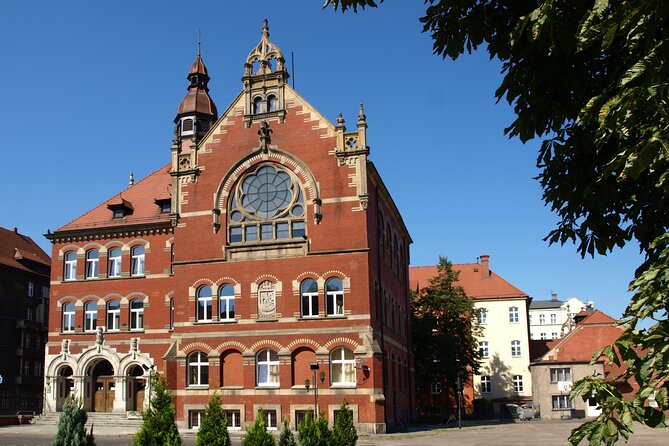
The tour’s most street-level section is the walk toward Stawowa. Along the way, you pass through Miarka Square, Dworcowa Street, and 3 Maja Street—each one a corridor for noticing how city neighborhoods develop.
At Stawowa, the tour asks you to appreciate 19th-century tenements. This is where the city looks like it grew in layers rather than being planned in one clean moment. Tenements show the practical side of history: where people lived, how facades were designed, and how buildings were used as the city expanded.
The stop also includes the oldest high school in Katowice, which adds a present-day meaning to the older streets. You’re not just looking backward—you’re seeing where education and daily life were formed and continued.
The tour also mentions the area as a place tied to community events—a venue for art exhibitions, international meetups, and other events. That’s a useful clue for you after the tour, because it suggests an area where you can keep experiencing the city without it feeling like another sightseeing trap.
A travel tip: this is also a segment where you’ll likely do more walking between viewpoints. Keep your pace steady so you don’t feel rushed when you reach the more architectural parts.
The 1939 scouts monument and the Silesian Insurgents’ Monument
After the Stawowa area, the route includes a monument commemorating Silesian scouts opposing Nazis in 1939. It’s a compact stop, but it adds emotional weight. The tour uses this moment to anchor the region’s modern history in a specific resistance story, not just broad political slogans.
Then you reach the Silesian Insurgents’ Monument (Pomnik Powstańców Śląskich), which commemorates three Silesian uprisings. This is the clearest “memory marker” on the route. It tells you what the region chose to remember, and how public space was used to reinforce identity across generations.
These monument stops can go two ways for visitors. If you like reflective moments, they’re strong. If you prefer cheerful sightseeing only, this is where you’ll feel the weight. Either way, I think they’re necessary, because without them, the architecture and institutions can feel like disconnected landmarks instead of symbols.
Spodek: Katowice’s city symbol in real space
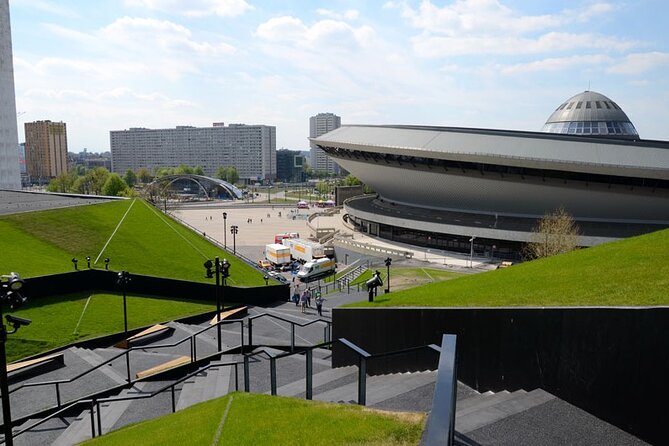
Finally, you end at Spodek, described as the symbol of Katowice. It’s one of those locations that works in two directions: you can look at it and think “future,” or you can use it as a closing point to summarize everything you saw earlier.
That’s the value of putting Spodek at the end. Earlier stops give you roots—square, churches, institutions, older streets, memory monuments. Spodek gives you the branch: Katowice as a modern city with its own recognizable shape.
The stop is listed around 10 minutes, so you’re not stuck. You’ll likely want a bit more time for photos, but the tour gives you enough to register the landmark and then head off to your next plan.
Price and value: what you’re really paying for
The tour is priced at $81.62 per person for about 3 hours. That’s not “cheap,” but it also isn’t built around paid museum entry or expensive attractions.
Here’s why the value can work:
- The itinerary includes admission ticket free for each listed stop, so you’re not stacking entry fees on top of the guide cost.
- You get a guided storyline in English, which helps you interpret what you’re seeing rather than guessing.
- It’s set up as a private tour/activity, meaning it’s only your group, not a long line of strangers. That often makes questions easier and explanations more direct.
The real question is fit, not price. If you want a fast guided overview with context—from Silesian politics to church art to city symbols—this cost can make sense. If you’re mainly chasing indoor museums, you might feel the time is more “walk and understand” than “walk and collect artifacts.”
What to bring and how to plan your walk
Because you’ll cover 6.5 km, I’d plan for comfort over style. Wear shoes you can handle on city sidewalks. Bring water, especially in warmer weather.
Good weather is required. If conditions are poor, the experience may be canceled and you’ll be offered a different date or a refund. So check the forecast the day before and be flexible.
It’s also offered in English, so if English is your working language, this is built for you. If you’re the type who enjoys asking follow-up questions, this format tends to reward that.
Also, you’ll use a mobile ticket, which is handy if you prefer not to manage printed confirmations while walking around.
Who this Katowice Old Town tour suits best
This is a strong choice if you want:
- A single guided loop to understand Silesian culture and identity
- Architecture and monuments explained with practical context
- A route that mixes old streets, religious sites, cultural institutions, and modern landmarks
It may be less ideal if you’re expecting long interior visits, long museum times, or deep archival detail. The stops are short by design, so the tour works best as your orientation chapter.
If you travel with kids, this could still work, but only if your group can handle steady walking and short attention blocks. For older teens and adults—especially history-curious people—it’s a natural fit.
Should you book this tour?
I’d book it if you like your travel with structure and meaning. You get a tight loop from Market Square through churches, music and political institutions, then monuments, and finally Spodek. With free entry at the listed stops and a guide-led explanation in English, it’s the kind of tour that helps you stop treating Katowice as a collection of buildings and start seeing it as one story.
I’d skip it or swap it if you hate walking and you can’t handle weather swings. Also, if your heart is set on long indoor museum time, this route is more about the city as a living map than a deep dive into archives.
FAQ
How long is the Katowice Old Town Walking Tour?
It runs for about 3 hours.
Where does the tour start?
The meeting point is Silesian Theatre, Rynek 10, 40-003 Katowice, Poland.
How far do you walk?
You walk about 6.5 km during the tour.
Is the tour offered in English?
Yes, it is offered in English.
Is admission included for the stops?
The listed stops are marked as admission ticket free.
Is this tour private?
Yes. Only your group participates.
When will I receive confirmation after booking?
Confirmation is received within 48 hours of booking, subject to availability.
What if the weather is bad?
The experience requires good weather. If it’s canceled due to poor weather, you’ll be offered a different date or a full refund.