The gate to Auschwitz changes how you see history. I liked the way an English-speaking tour leader helps you get oriented quickly, and I liked the self-guided walking time once you’re inside. The one thing to think about is that this is a long, heavy visit, and timing can shift slightly once you’re at the museum.
For $38.05 you’re not just buying access. You’re also paying for round-trip transport and an assistance-first approach that keeps you from wasting time figuring out what goes where. With a maximum of 30 people, the day still feels organized rather than chaotic.
In This Review
- Key things to know before you go
- Krakow to Oświęcim: the ride, the meeting point, and the real timing
- Getting your bearings at Auschwitz I, with an expert setting the map
- Walking Auschwitz I at your own pace: barracks, fences, and exhibitions
- Birkenau (Auschwitz II): why the second camp changes everything
- The day’s flow, from a brief break to a calm return to Krakow
- Price and value: what $38.05 really covers
- Who this tour fits best (and who might want a different format)
- Should you book this Auschwitz-Birkenau self-guided day trip from Krakow?
- FAQ
- How long is the Auschwitz-Birkenau self-guided tour from Krakow?
- Where is the meeting point in Krakow, and what time does the tour start?
- What is included in the $38.05 price?
- Is the experience fully guided or self-guided?
- Is this tour suitable if I don’t want too much walking?
- Can I cancel and get a refund?
Key things to know before you go
- English orientation before you walk on your own so you know what you’re looking at
- Auschwitz I first, then the much bigger Birkenau (Auschwitz II) for context and contrast
- Tickets are included, which matters at a site that can be time-sensitive
- Small group size (max 30) for a smoother meet-up and re-group
- A long day (about 7–8 hours) with time built in for breaks and the drive
Krakow to Oświęcim: the ride, the meeting point, and the real timing
This day trip starts in Krakow at Pawia 18B, 31-154 Kraków, with a start time of 2:30 pm. You’ll travel by comfortable, air-conditioned minivan or bus, and the ride is about 1.5 hours each way.
What I like about this setup is that it reduces your stress right away. Instead of finding schedules, lining up transport, and building your own path to Oświęcim, you show up, meet your group, and go. That matters here because the site is large, the experience is emotionally demanding, and you don’t want to spend your limited on-site time just trying to orient.
One practical note: your schedule can shift due to the Auschwitz Museum’s operating timing. So keep your expectations flexible. If you’re the type of traveler who likes perfectly timed connections, this is not the tour for tight planning after you return to Krakow.
You can also read our reviews of more guided tours in Krakow
Getting your bearings at Auschwitz I, with an expert setting the map
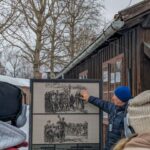
Before you go walking on your own, you get help entering and understanding the place. On arrival, you’ll meet a local guide who is a licensed expert from the Auschwitz-Birkenau museum. This is the part that turns the visit from random walking into something you can actually follow.
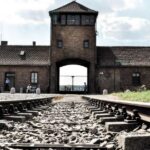
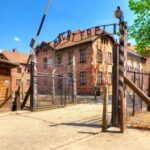
The orientation focuses on Auschwitz I, including the layout of the grounds and the key areas you’ll be seeing. You’ll pass through the infamous gate at Auschwitz I, with the inscription Arbeit Macht Frei. Even if you know the words and the dates already, standing under that kind of gateway hits different because it puts history into a physical frame.
Auschwitz I matters because it’s where the machinery of incarceration and mass murder took shape on this site. The memorial explains that the camp was established in 1940, repurposing old Polish army barracks. It began with Polish POWs and political prisoners and later became part of the system that carried out mass killing on a staggering scale. The museum context given here is clear: more than 1.5 million people were brought to Auschwitz, including Jews, Poles, Italians, and French, and 1.1 million were exterminated. The visit is therefore not only about structures. It’s about understanding how the system operated.
Walking Auschwitz I at your own pace: barracks, fences, and exhibitions
Once the leader helps you get in smoothly and explains the layout, you get entry tickets that let you explore independently. That self-guided time is a big deal. You can slow down where you need to, move faster where your brain is coping better, and spend extra moments in the preserved areas that linger in your mind.
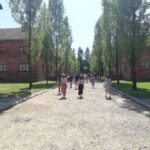
At Auschwitz I, you can expect to see preserved barracks, original fences, watchtowers, and museum exhibitions. Even without a live guide speaking continuously, the physical elements do a lot of the explaining. The point isn’t to “collect facts.” It’s to let the site show you what the prisoners were forced to live with: confinement, surveillance, and the cold geometry of control.
This is also where I think the self-guided format shines for many people. A guided-only script can be useful, but it can also feel fast. Here you can pause, read at your own pace, and process. You can also step away briefly if you need a reset, then come back to the same exhibit when you’re ready.
The drawback is simple: you won’t have someone answering your specific questions inside every building. So if you’re the kind of traveler who likes a constant narrative voice, you may wish the onsite guiding lasted longer. The trade-off is that the pacing becomes yours.
Birkenau (Auschwitz II): why the second camp changes everything
After your time at Auschwitz I, you go to Brzezinka, which is where Birkenau (Auschwitz II) sits. Birkenau is the larger extermination camp and it’s the part that many people remember most. It is also the part that makes the scale of what happened more visible.
Here are the key context points the visit emphasizes. Construction began in October 1941 by slave laborers, and the camp was built on the site of the displaced and largely destroyed village of Brzezinka, about three kilometers from Auschwitz I. The camp design could hold up to 125,000 prisoners at a time. Later, Birkenau became a central hub for the extermination of Jews, after beginning as a place that held Soviet POWs.
When you walk through Birkenau on your own, you can feel why this camp is treated as a core part of any Auschwitz-Birkenau visit. The layout is much broader, and the distances matter. You start to understand how a system could be run at industrial scale: huge capacity, rigid movement, and conditions that were designed to destroy life through cold, hunger, and disease—along with an early knowledge that many prisoners were condemned to die.
This is heavy. But it’s also where the visit becomes more than an “information stop.” Your own pace helps you keep your footing emotionally. Some parts you’ll want to look at longer. Other parts you might need to move through more quickly. Either way, Birkenau rewards the choice.
The day’s flow, from a brief break to a calm return to Krakow
The tour rhythm is built around realistic travel time and the museum’s pace.
After you meet in Krakow and get going, you’ll have a brief break on arrival in Oświęcim. It’s a small window, but it’s practical: you can grab a coffee or stretch your legs before you enter the memorial grounds.
On the way back, you don’t get rushed immediately. There’s at least 15 minutes for a bookstore stop or just a breather, followed by about 1 hour 30 minutes on the road back to your Krakow meeting place. That matters because you’ll likely feel tired in more than one way. A memorial site drains you. Having a little decompression time before you hit the traffic helps.
Also, check the length of your day. This trip runs about 7–8 hours, so plan to treat it as your whole afternoon and evening. Don’t schedule “one more thing” right after return unless you’re comfortable being tired and emotionally wrung out.
You can also read our reviews of more tours and experiences in Krakow

Price and value: what $38.05 really covers
At $38.05 per person, the value here comes from combining three things that are not always easy to bundle on your own:
- Round-trip transportation from Krakow (minivan or bus, air-conditioned)
- Entry tickets to the memorial site
- Assistance from a tour leader, including help with entering and an orientation to the Auschwitz I and Auschwitz II layout
So you’re paying for less friction. Instead of spending time figuring out transport, ticket timing, and the best “how do I start?” plan, you get a structured start and then freedom to explore.
There’s also the group element. With a maximum of 30 travelers, you’re not stuck in a crowd that makes self-guided walking feel impossible. You re-group after your time inside, but the group size keeps the process from feeling like cattle herding.
One more detail that affects value: this tour is often booked about 71 days in advance on average. That tells me demand is steady, and the best plan is to lock it in early rather than gamble.
Who this tour fits best (and who might want a different format)
This day trip works best if you want a structured start but prefer to experience the memorial at your own pace.
You’ll probably love it if:
- You like self-guided freedom inside large, emotionally heavy spaces
- You want a licensed expert to set up the layout so you don’t wander aimlessly
- You’re comfortable with moderate walking and a long day
You might consider a different option if:
- You need constant commentary to stay oriented
- You strongly dislike the idea of navigating without an onsite guide for every question
- You’re trying to fit this around tight later plans, since museum timing can shift
The “moderate physical fitness” note is also real. The site has walking involved, and you should expect time spent on your feet.
Should you book this Auschwitz-Birkenau self-guided day trip from Krakow?
Yes, if you want a practical, no-drama way to visit Auschwitz-Birkenau with an expert orientation and then meaningful time to walk on your own. The biggest strength is that you get help to start right, then you control your pace in both Auschwitz I and Birkenau. That combination helps the experience feel guided enough to be understandable, but personal enough to be processed.
Book it if you care about value and structure. You’re paying for transport and tickets, and you’re not left trying to stitch together logistics in a place where time and clarity matter.
Just go in with the right mindset. This is not a “sightseeing day.” It’s a heavy memorial visit where slowing down is part of respecting what you’re seeing.
If you’re ready for that tone, this is a solid way to do it from Krakow.
FAQ
How long is the Auschwitz-Birkenau self-guided tour from Krakow?
The tour lasts about 7 to 8 hours.
Where is the meeting point in Krakow, and what time does the tour start?
The meeting point is Pawia 18B, 31-154 Kraków, Poland, and the start time is 2:30 pm. The tour ends back at the same meeting point.
What is included in the $38.05 price?
The price includes transportation from Krakow, entry tickets, and assistance from a tour leader to help with entering and understanding the layout.
Is the experience fully guided or self-guided?
You’ll have help from an English-speaking tour leader and a licensed expert orientation. After that, you use the entry tickets to walk through the camps independently.
Is this tour suitable if I don’t want too much walking?
The tour recommends travelers have moderate physical fitness. The group size is limited to a maximum of 30 travelers.
Can I cancel and get a refund?
No. This experience is non-refundable and cannot be changed for any reason. If you cancel or ask for an amendment, the amount paid is not refunded.