REVIEW · KRAKOW
The best view of Krakow from Golf Cars
Book on Viator →Operated by Michal Urban · Bookable on Viator
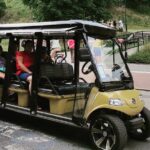
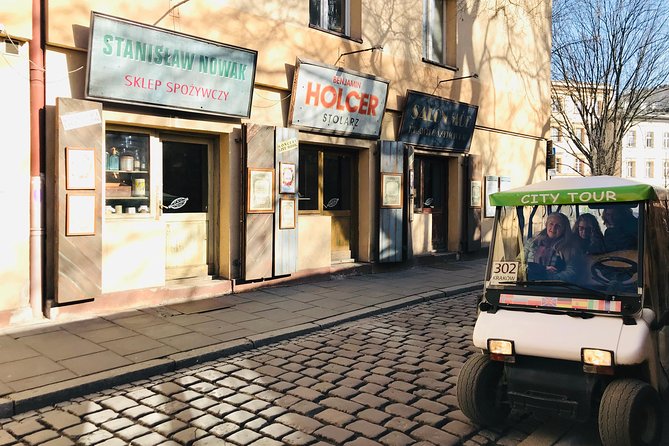
A golf cart tour can turn Krakow from a list of stops into a smooth story. This one is fun because you cover big sights fast, yet still get into spots bigger buses can’t reach, with easy audio guidance in 26 languages. You also get a small group setup—max seven—so it doesn’t feel like cattle-farming history.
What I like most is the format: short, well-chosen stops where you can hop out, look around, and then roll on. The driver provides an English-speaking take on the city while the audio guide handles the longer explanations, which makes the whole two-hour loop feel efficient without feeling rushed.
One drawback to think about: cart-based tours depend on operations and timing. If the vehicle doesn’t show right away, there’s no “just wait for the next bus” option—so arrive at the meeting point on time and keep your confirmation handy.
In This Review
- Key highlights you should care about
- Why Krakow Feels Different From a Golf Cart
- Price and value: $103.03 per group (up to 7)
- Two hours of “see it, then move on” pacing
- From plac Jana Matejki to the Old Town gateway
- Grunwald Monument and the Old Town ring of greenery
- Wawel Castle and the UNESCO-worthy setting
- Monument of the Wawel Dragon: folklore with a real address
- Bernardine Church and Church on the Rock: faith and architecture close up
- Entering Kazimierz via Wolnica Square
- Father Bernatek Footbridge: a short ride with a cross-river feel
- Corpus Christi Church: Gothic meets Baroque inside
- Tempel Synagogue and the layered story of Kazimierz
- Stara Synagoga (Old Synagogue): when “oldest” hits
- Szeroka Street: the heart of Kazimierz
- Remuh Synagogue area: sacred art and continued religious life
- Plac Bohaterów Getta: ghetto memory, including the pharmacy museum
- Podgorze finish: Church of St. Joseph
- What’s included, what’s not, and what you should bring
- Should you book this Krakow golf cart tour?
- FAQ
- How long is the Krakow golf cart tour?
- What is the group size?
- Is pickup available, or do I meet at a specific place?
- Do I need tickets for the stops?
- Is there an audio guide?
- Is the driver English speaking?
- Does the tour work in bad weather?
- What is included besides the driving and guide?
- Is food or drinks included?
- How much does the tour cost?
- Can I cancel and get a full refund?
Key highlights you should care about
- Small-group max seven means you can actually ask questions and get photo pauses
- Electric golf carts help you reach places large tour buses miss
- 26-language audio guide keeps the monuments understandable even on the move
- Wawel to Kazimierz arc: Old Town landmarks plus the Jewish quarter and ghetto memorial areas
- Short walks, mostly on your feet: quick look, quick photo, then back in the cart
- Photos during the tour add a low-effort souvenir
Why Krakow Feels Different From a Golf Cart
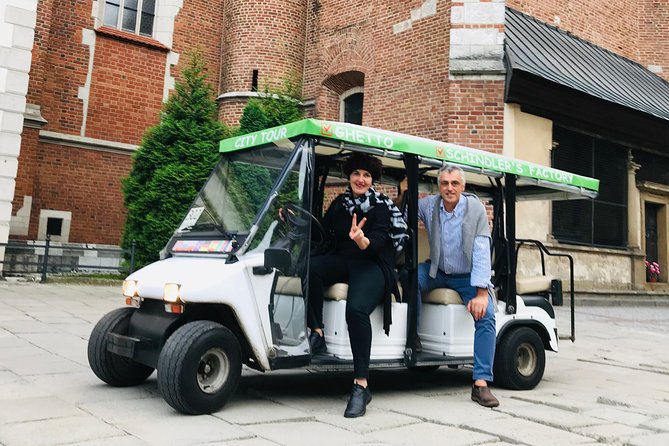
Krakow is a city where the details matter. But the details take time—time you might not have when you’re bouncing between churches, squares, and museums. This tour solves that problem by letting you see a lot without doing a full-on walking marathon.
You ride in an electric golf cart with a driver who speaks English. While you move through town, you’re not stuck staring at the back of someone’s head. The cart format makes it easier to pivot, glance at views, and get to the next landmark while the first one is still fresh in your mind.
And because it’s designed as a small-group outing, the pacing matches real sightseeing. You stop, you look, and you keep rolling. That’s a nice change from “20 minutes here, 5 minutes there” bus tours.
You can also read our reviews of more tours and experiences in Krakow.
Price and value: $103.03 per group (up to 7)
At $103.03 per group for up to seven people, the math works best when you’re traveling with friends or family. If you’re solo, it may feel pricier than a standard walking tour—but it’s still paying for a private vehicle experience plus an organized route that hits a lot in about two hours.
Here’s how I judge value on a tour like this:
- You’re getting guided narration, not just a self-guided audio track.
- You also get audio in 26 languages, plus photos taken during the ride.
- The route focuses on major landmarks in both the Old Town and Kazimierz, including the ghetto memorial area.
If you want the fastest way to get your bearings and you’re okay with a mix of riding and short walks, this price can feel reasonable. If you’d rather spend that money on museum tickets and a slower wander, you may prefer to build your own loop.
Two hours of “see it, then move on” pacing
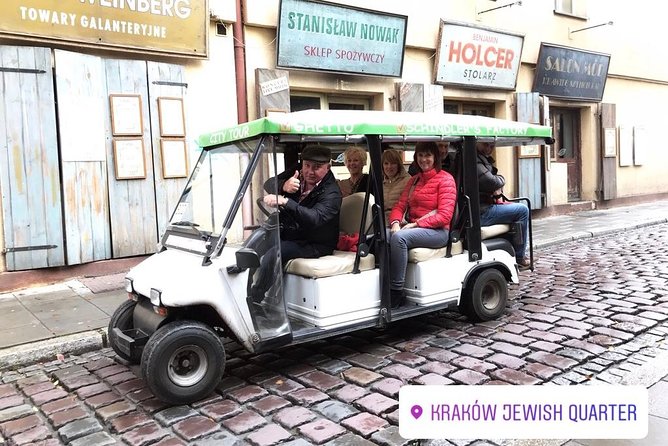
The total time is about two hours. That matters because Krakow can quietly steal hours from you. This tour is structured to prevent that. You’ll visit major monuments and viewpoints along the Wawel Hill area, then continue into Kazimierz for Jewish-quarter highlights and ghetto reminders.
Expect a rhythm of:
- ride through streets and squares,
- step out briefly for photos and quick looks,
- hear context from the driver plus the audio track.
It’s not a deep lecture tour where you stay for long museum hours. Think of it as a high-impact orientation plus “great hits” sightseeing.
From plac Jana Matejki to the Old Town gateway
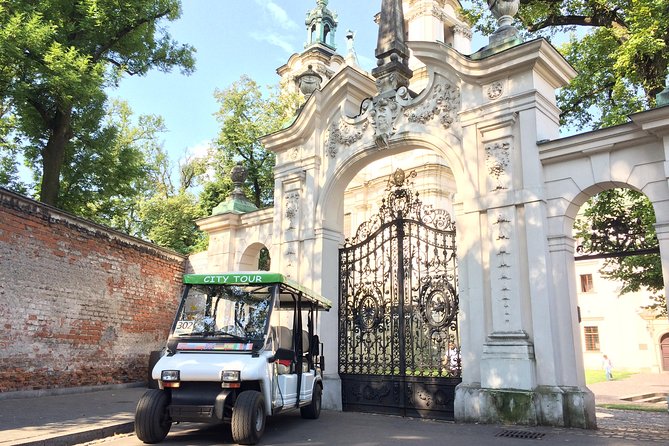
The tour starts at plac Jana Matejki 2 and returns there. You’ll also see that pickup is offered, but the meeting point is clearly identified, so I’d plan to be ready there rather than assuming pickup will sweep you off the sidewalk.
One of the first Old Town area elements you’ll pass is a historic gateway built around 1498—a clue that you’re entering an older, more fortified street grid than modern Krakow visitors expect.
This early segment helps in a practical way: you start understanding the city’s shape before you start naming monuments. Once you’ve got that mental map, the rest of the stops land better.
Grunwald Monument and the Old Town ring of greenery
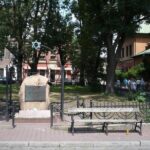
Next up is the Grunwald Monument, tied to the Battle of Grunwald—a major medieval conflict that’s remembered as a key Polish-Lithuanian victory. It’s an “outside-looking-in” moment: rather than standing inside a church, you’re looking at a public statement in stone and steel about national pride and shared history.
Then you head toward one of the city’s major parks—an area that historically encircles the Old Town. You’ll learn that these grounds relate to the medieval city walls that stood until the early 19th century. That’s a useful story because Krakow’s core feels enclosed even today, and the park helps you visualize where the old barriers once were.
Wawel Castle and the UNESCO-worthy setting
The tour brings you past the Wawel Castle, which is now one of Poland’s premier art museums. It was declared a UNESCO World Heritage Site in 1978 as part of the Historic Centre of Krakow.
Even if you don’t go inside, the castle location explains a lot. You can understand why this area became the center of Polish statehood for centuries. Standing near the complex from the right angles makes the surrounding streets and viewpoints feel intentional, not random.
Monument of the Wawel Dragon: folklore with a real address
One of the most memorable stops is the Monument of the Wawel Dragon. The dragon is a character from Polish folklore, and its lair is tied to a cave at the foot of Wawel Hill by the Vistula River.
This is one of those places where stories become landmarks. You’ll be able to point it out later and say, yes, Krakow had a dragon legend, and yes, it has a physical spot you can still visit.
Tip: if you’re traveling with kids or anyone who likes myths, this is a quick stop that gives personality to the trip. It breaks up the more formal architecture and memorial themes.
Bernardine Church and Church on the Rock: faith and architecture close up
From Wawel Hill’s area, you stop near the Bernardine Church at the foot of the hill. The present building dates to the second half of the 17th century, and the baroque church component is linked to 1719–1728. In plain terms, this is Krakow’s “religion made visible” phase—baroque details and a church façade that feels built for presence.
Then you move to Church on the Rock (Kościół na Skałce). This one has a great backstory: King Casimir III raised a gothic church, and since 1472 the shrine has been in the possession of a monastic community of Pauline Fathers. Later, baroque decoration came in 1733–1751, and the church is one of Poland’s better-known sanctuaries.
What I like about including churches on a golf cart tour is that they’re naturally photogenic, and you don’t need long travel distances. You get context, you get a strong visual, and you keep going.
Entering Kazimierz via Wolnica Square
Then the scenery shifts. You enter Kazimierz, the historic Jewish district area, and begin with Wolnica Square, part of the old market square in Kazimierz.
This matters because Kazimierz isn’t just one street or one building. It’s a neighborhood of squares, markets, and religious sites. Starting in a square helps you understand the social layout—where people gathered, where commerce happened, and where community life took shape.
Father Bernatek Footbridge: a short ride with a cross-river feel
A quick hop lands you at the Father Bernatek Footbridge (Kładka Ojca Bernatka). It crosses the Wisła River just south of the center and connects Kazimierz and Podgorze. The stop is short, but it provides a satisfying change of perspective.
If you’ve only seen Krakow from viewpoints near the Old Town, this helps you connect the neighborhoods spatially. It also gives your legs a rest—just enough walking to reset after the previous stops.
Corpus Christi Church: Gothic meets Baroque inside
Next is the Corpus Christi Church (Kościół Bożego Ciała), founded by King Casimir III the Great in 1335. The interior is described as a mix of Polish Gothic and impressive Polish Baroque architecture.
Even if you don’t linger, the idea of “Gothic bones, Baroque clothing” is a theme worth noticing in Krakow. This stop helps you see how architectural style evolved without the city feeling like it got replaced.
Tempel Synagogue and the layered story of Kazimierz
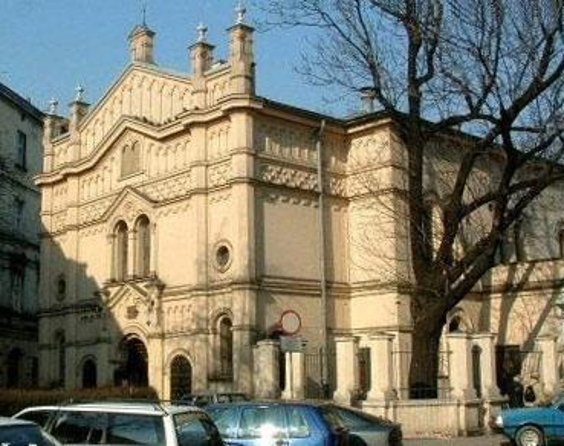
You’ll visit Tempel Synagogue, known as the Progressive Synagogue built in the 1860s. The provided details also point to older synagogue origins and the fact that during the German occupation it was devastated.
Places like this matter for a specific reason: you’re not looking at a single-page history. You’re looking at a site that got built, changed, damaged, and then remembered. It’s a reminder that the Kazimierz story isn’t static.
Nearby, the tour also highlights elements connected to Kazimierz’s old Jewish city layout, including the characteristic Okrąglak market hall (built 1899–1900 as a roofed market hall) and the mention of the High Synagogue as the third to be built in the Jewish city.
The key: you get the neighborhood’s geography, not just one monument.
Stara Synagoga (Old Synagogue): when “oldest” hits
One of the stand-out learning stops is Muzeum Krakowa – Stara Synagoga. It’s described as the oldest synagogue, built either 1407 or 1492 (the info given leaves some ambiguity). Inside, there’s a permanent exhibition focused on judaica.
This is also one of the times you may choose your pace. The tour time at the stop is brief, and the museum entry isn’t included. That means you can use it as either:
- a quick exterior + audio context moment, or
- a decision point to pay attention and potentially add extra time if you’re keen on the exhibits.
If museums are your thing, you might want to come back later on another day.
Szeroka Street: the heart of Kazimierz
Then you reach Szeroka Street, described as the heart of the Jewish district of Krakow. This is the kind of stop where the scale of the street matters. Even a short look lets you picture community life along a major thoroughfare.
This is also where you start appreciating how Kazimierz works as a living neighborhood today. Even on a short tour, you can feel that you’re not just “touring history”—you’re moving through a place that still has its own rhythm.
Remuh Synagogue area: sacred art and continued religious life
Next is Remuh Synagogue (Synagoga Remuh), described as a unique complex of Jewish architecture and sacred art from the mid-16th century that remained a centre of religious life.
If you prefer your history to include continuity—not only rupture—this stop helps. You’re not just hearing about what happened. You’re seeing a place that kept functioning.
Again, entry isn’t included, so your time at the stop can be either quick or more intentional depending on your interests and schedule.
Plac Bohaterów Getta: ghetto memory, including the pharmacy museum
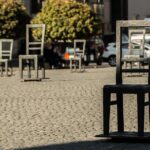
The tour then moves into the darker part of the city narrative: Plac Bohaterów Getta, tied to the Kraków Ghetto created by Nazi Germany as one of five major metropolitan ghettos.
Here, you get multiple connected elements:
- the ghetto’s memorial context,
- the only pharmacy in the Krakow ghetto, with an inside museum exhibition,
- a fragment of the ghetto wall on Lwowska street,
- information about where the ghetto entry gate was located (at the beginning of Limanowskiego Street, diverging from Podgórze Market Square during 1941–1943).
This is the part of the tour where I think the golf cart format is actually useful. You’re moving between several sites linked by the same story, and you can take short moments to absorb each one without losing the thread.
Podgorze finish: Church of St. Joseph
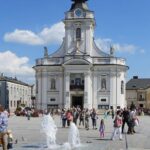
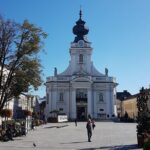
The last stop before returning is Church of St. Joseph at Podgorze Square, dating to the 20th century. It’s a quieter ending point—more modern than Wawel, less mythic than the dragon, and less directly museum-based than the synagogue sites.
Ending here helps the day feel complete: you’ve covered medieval power (Wawel), artistic religion (church stops), neighborhood identity (Kazimierz), and Holocaust remembrance (Plac Bohaterów Getta).
What’s included, what’s not, and what you should bring
This tour is built for a low-effort experience on your part.
Included:
- Guided tour in electric golf car
- Audio guide system in 26 languages
- English speaking driver
- Photos during the tour
Not included:
- Food and drinks
- Some sites (like Tempel, Stara Synagoga, and Remuh Synagogue) specifically list admission as not included.
What I’d bring:
- Comfortable shoes for the short walk segments and steps around churches and squares
- A charged phone for photos (since you’ll also get photos taken during the tour)
- A light layer: even in nicer weather, Krakow evenings near rivers can get chilly
Also, the tour mentions city tours can happen on cold or rainy days thanks to special covers on the vehicles. Still, it may require decent conditions—so I’d be ready with a backup plan if weather forces a change.
Should you book this Krakow golf cart tour?
Book it if you want:
- a fast, organized way to see both Old Town and Kazimierz in about two hours
- small-group attention with an English-speaking driver
- a mix of famous landmarks and “you can’t reach this by bus” angles
Skip or reconsider if:
- you only want museum time and don’t care about quick exterior-and-story stops
- you’re the kind of person who needs long, unstructured wandering without scheduled movements
- you’re traveling with a group big enough that the “max seven” setup won’t work for your needs
My practical take: this is a great first-day Krakow activity. It helps you build a mental map, connects landmarks to actual stories, and gets you to the key Jewish-quarter and ghetto-related sites without turning the trip into a marathon.
FAQ
How long is the Krakow golf cart tour?
The tour lasts about 2 hours.
What is the group size?
It’s a small-group tour with a maximum of 7 travelers.
Is pickup available, or do I meet at a specific place?
Pickup is offered. The meeting point is plac Jana Matejki 2, 31-157 Kraków, Poland, and the tour ends back at the meeting point.
Do I need tickets for the stops?
Some stops list admission as free, while certain synagogue-related stops (Tempel Synagogue, Muzeum Krakowa – Stara Synagoga, and Remuh Synagogue) indicate admission is not included.
Is there an audio guide?
Yes. You get an audio guide system in 26 languages, and it works through your language.
Is the driver English speaking?
Yes, the tour includes an English speaking driver.
Does the tour work in bad weather?
The tour notes that city tours are possible on cold and rainy days because the vehicles have special covers, but it also says the experience requires good weather and may be canceled due to poor weather.
What is included besides the driving and guide?
The tour includes photos taken during the tour, plus the audio guide system.
Is food or drinks included?
No. Food and drinks are not included.
How much does the tour cost?
It costs $103.03 per group for up to 7 people.
Can I cancel and get a full refund?
Yes. You can cancel up to 24 hours in advance for a full refund. If you cancel less than 24 hours before the start time, the amount paid is not refunded.